You send the text and put your phone down.
You don’t reread it six times, checking to see whether you sounded rude, needy or somehow wrong. You disagree with someone close to you without wondering whether the relationship will survive it. You turn down an invitation without inventing an excuse to soften the no. When something hurts you, you say so without worrying that speaking up will somehow become the bigger problem.
None of this sounds particularly remarkable.
Maybe that is why we rarely talk about it.
We have spent years learning to identify the signs of unhealthy relationships. We know the red flags. Gaslighting. Manipulation. Love bombing. Toxic behavior. We have learned to study what people say, what they leave unsaid and all the little things in between.
But we have far less language for what a healthy relationship actually feels like.
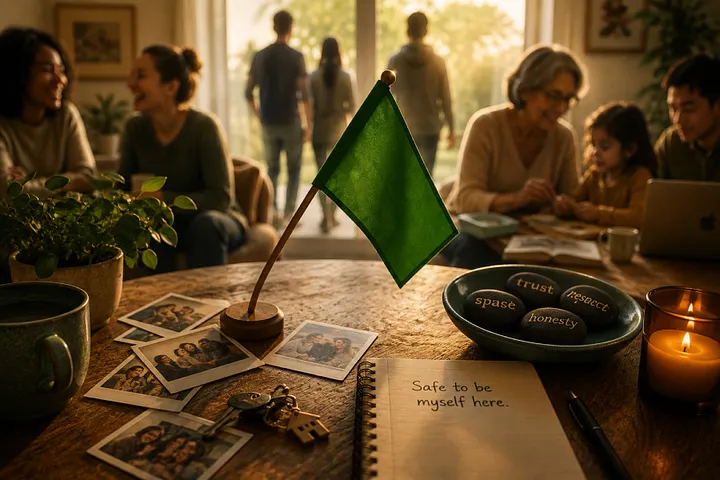
Maybe some of the greenest flags are the ones we never learned to look for.
You Don’t Have to Be a Detective
One of the greenest flags in any relationship is how little detective work it requires.
A friend says they’re busy, and you believe them. You don’t scroll back through the conversation looking for the moment their tone changed. A family member is upset with you and tells you why. Someone you care about has a bad day, and your first thought isn’t to wonder what you did.
People still get quiet when they should speak, choose the wrong words and expect others to know what they never actually said. Misunderstandings happen in every relationship. They just don’t become the relationship.
When someone is consistent about what they say, how they act and what they expect from you, you stop searching for meanings that may not be there. A strange mood can simply be a strange mood. A short text can simply be a short text.
And when something really is wrong, you don’t have to piece it together from clues. You can ask what happened and trust that you’ll get an answer.
Sometimes, though, that answer won’t be the one you wanted to hear.
You Can Disappoint Someone Without Being Punished for It
Sometimes the answer you don’t want to hear is no.
A friend can’t make dinner. Your adult child is spending the holiday somewhere else. Your partner wants the evening alone. People we care about will sometimes make choices we wish they wouldn’t.
And sometimes we will do the same to them.
Disappointment belongs in healthy relationships too. Someone may need time to cool off or tell you plainly that they wish you had made a different choice. What matters is what happens afterward.
The no doesn’t become something you have to pay for. Affection isn’t withdrawn until you give in. Nobody spends three days barely speaking to you, takes a shot at you in front of other people or keeps returning to your decision until guilt finally does what asking couldn’t.
A green flag isn’t someone who never gets upset with you. It’s someone you are still safe with when they are.
That kind of relationship leaves room for two people to want different things without making the relationship itself feel threatened. You can disappoint each other and remain close. You can make choices the other person wouldn’t make.
And sometimes those choices begin to change who you are.
You Are Allowed to Change
Some of the healthiest relationships in your life will be with people who let you outgrow the version of you they first knew.
That sounds simple until you think about how long some people have known you. Families and old friends can carry versions of us that stopped being accurate years ago. You’re still the sensitive one. The irresponsible one. The successful one. The difficult one. The peacemaker who smooths everything over before anyone else gets uncomfortable.
Stay in a role long enough and people can start mistaking it for who you are.
But people change. You become more confident. You have less time to give. You set a boundary that didn’t exist five years ago. Maybe you simply change your mind about something you once swore you never would.
The people who know how to grow with you get curious about who you are now. They may miss parts of the old dynamic or need time to adjust, but they don’t ask you to squeeze yourself back into a version you’ve already outgrown just to make the relationship easier for them.
Being known for a long time shouldn’t mean being known only as you were.
And changing shouldn’t make you wonder whether you still have a place in someone’s life.
You Don’t Have to Earn Your Place
Sometimes belonging comes with conditions you don’t notice at first.
You’re included when you’re useful. Appreciated when you’re agreeable. Called when somebody needs something. After a while, you notice that the easiest version of you is also the one everyone seems to like best.
Relationships aren’t perfectly balanced. There will be months when one friend calls more than the other. A sibling may go through something difficult and have very little to give. A partner may carry more for a while. Keeping score would miss the point.
Over time, care should move in both directions. But your value to someone shouldn’t depend on what you’ve done for them lately. You shouldn’t have to stay useful, entertaining, available or easy to keep your place.
You know a relationship is healthy when you can occasionally have nothing to offer and still know you belong there.
Maybe you’re exhausted. Maybe you’re struggling. Maybe, for once, you need more than you can give. There should be room for that version of you too.
And sometimes the clearest sign that you belong is how little you have to think about whether you do.
The Green Flags Are Usually Quieter
Think about the people around whom you don’t rehearse what you’re going to say. You don’t check their mood before deciding which version of yourself to bring into the room. You can be tired, distracted or have a bad day, and nothing about the relationship suddenly feels different.
These relationships rarely give us the best stories. Nobody screenshots a completely reasonable text exchange and sends it to six friends asking, What do you think they meant by this? Nobody lies awake wondering why everything went fine.
We have learned to notice the relationships that leave us anxious, confused or unsure of where we stand. Maybe we should get better at noticing the ones that don’t demand so much of our attention. The people whose words don’t need translating. The conversations we don’t have to replay. The silence we don’t rush to fill.
Sometimes the biggest green flag is realizing you stopped looking for flags at all.
Sources
Deci, Edward L., and Richard M. Ryan. “The ‘What’ and ‘Why’ of Goal Pursuits: Human Needs and the Self-Determination of Behavior.” Psychological Inquiry 11, no. 4 (2000): 227 — 268.
Reis, Harry T., and Phillip R. Shaver. “Intimacy as an Interpersonal Process.” In Handbook of Personal Relationships, edited by Steve Duck, 367 — 389. Chichester, UK: Wiley, 1988.
Rusbult, Caryl E., and Paul A. M. Van Lange. “Interdependence, Interaction, and Relationships.” Annual Review of Psychology 54 (2003): 351 — 375.
Gottman, John M., and Nan Silver. The Seven Principles for Making Marriage Work. New York: Crown Publishers, 1999.