Most people believe they know exactly what they are attracted to until they look back at their relationship history.
The woman who insists she wants stability finds herself repeatedly drawn to emotionally unavailable partners. The man who claims physical appearance is his highest priority discovers that the relationships he cherishes most were built around connection, trust and emotional intimacy. Dating profiles are filled with carefully constructed descriptions of ideal partners, yet attraction often seems to ignore the checklist entirely.
This contradiction has fascinated psychologists, neuroscientists, anthropologists and relationship researchers for decades. If attraction were as simple as finding someone physically appealing, relationships would be remarkably easy. Instead, people routinely find themselves captivated by individuals who do not fit their stated preferences, confused by powerful chemistry that seems to appear out of nowhere and surprised by how quickly intense attraction can either deepen into love or disappear altogether.
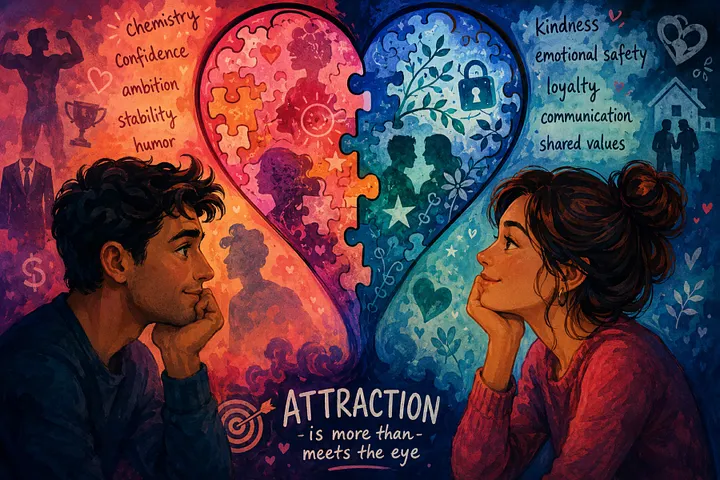
The truth is that attraction is far more complicated than most people realize. It exists at the intersection of biology, psychology, personal history, social influence and emotional experience. What initially captures our attention is often very different from what ultimately earns our trust, sustains our affection and creates a lasting bond.
Understanding attraction requires moving beyond popular myths and examining what research actually reveals about desire, dating and long-term love.
Attraction Begins Before We Are Aware of It
One of the most surprising discoveries in relationship science is that attraction often develops before conscious thought has a chance to weigh in. Long before someone evaluates whether a potential partner is intelligent, successful or compatible, the brain is rapidly processing thousands of subtle signals.
Researchers have found that people form powerful impressions within seconds of meeting someone. Facial expressions, body language, vocal tone, scent, movement, eye contact and emotional energy all contribute to these instantaneous evaluations. While many people believe attraction is a deliberate decision, much of it operates beneath conscious awareness.
From an evolutionary perspective, this makes sense. Human beings evolved in environments where rapid assessments of others could influence survival and reproduction. Although modern dating looks very different from life thousands of years ago, the underlying neural systems remain extremely similar.
This is to to say attraction is purely biological. Rather, biology creates the initial spark while psychology and experience determine whether that spark grows into something meaningful.
The first moments of attraction are often less about logic and more about recognition. Something about another person feels familiar, intriguing, safe, exciting or emotionally significant, even when we cannot immediately explain why.
What Men Are Actually Attracted To
Popular culture often portrays men as primarily motivated by physical appearance, but the research paints a much more nuanced picture.
Physical attraction certainly plays a role, particularly during initial encounters. Numerous studies have shown that visual cues can strongly influence first impressions. However, when researchers examine what predicts relationship satisfaction and long-term commitment, appearance becomes only one piece of a much larger puzzle.
Men consistently report being drawn to warmth, kindness, emotional stability, authenticity and reciprocity. While physical attraction may open the door, qualities that make someone enjoyable, trustworthy and emotionally available tend to determine whether a relationship progresses.
Interestingly, men often place a greater emphasis on emotional safety than they publicly admit. Many men describe feeling deeply attracted to partners who make them feel accepted, respected and understood. In clinical settings, it is not uncommon to hear men discuss physical attraction initially, only to later reveal that emotional connection ultimately became the defining factor in their most meaningful relationships.
Research also suggests that men are highly responsive to emotional responsiveness. Feeling appreciated, valued and emotionally supported can significantly strengthen attraction over time. In many cases, emotional intimacy enhances physical attraction rather than existing separately from it.
This challenges the stereotype that men prioritize appearance while women prioritize emotional connection. Human attraction is considerably more complex than those simplistic assumptions suggest.
What Women Are Actually Attracted To
Women are frequently portrayed as seeking confidence, status and ambition above all else. While these characteristics can influence attraction, they represent only part of a much larger story.
Research consistently demonstrates that women tend to evaluate potential partners through multiple dimensions simultaneously. Physical attraction matters, but so do emotional intelligence, reliability, competence, humor, communication skills and the ability to create psychological safety.
One of the most misunderstood findings in attraction research involves confidence. Women often report being attracted to confidence, but genuine confidence differs dramatically from arrogance. True confidence tends to communicate security, emotional maturity and resilience. Arrogance often communicates insecurity disguised as superiority.
Women also appear highly attuned to emotional regulation. A partner’s ability to navigate stress, handle conflict and maintain emotional stability frequently plays a significant role in long-term attraction. This does not mean women seek perfection. Rather, they seem to value the capacity for self-awareness and emotional growth.
Another consistent finding involves trustworthiness. While excitement and chemistry may generate initial interest, trust becomes increasingly important as relationships deepen. A person who appears exciting but unpredictable may generate strong attraction initially, but often struggles to maintain long-term relational stability.
Perhaps most importantly, women frequently describe attraction as something that evolves. Characteristics that might seem neutral during a first interaction can become deeply attractive once emotional intimacy develops. Unlike popular narratives that portray attraction as instantaneous and fixed, many women report that emotional connection can significantly influence physical attraction through time.
Why We Often Want One Thing but Choose Another
If people generally know what makes a healthy relationship, why do so many repeatedly find themselves attracted to partners who create distress?
The answer lies in the difference between conscious preferences and unconscious attraction.
Conscious preferences involve what people believe they want. They are the qualities individuals list when describing an ideal partner. Unconscious attraction, however, is shaped by years of emotional learning, family experiences, attachment patterns and relationship history.
People are naturally drawn toward what feels familiar. Unfortunately, familiar does not always mean healthy.
Someone raised in a household characterized by emotional unpredictability may unconsciously associate inconsistency with love. A person who grew up feeling overlooked may become intensely attracted to partners whose attention feels difficult to earn. Another individual may repeatedly pursue emotionally unavailable people because emotional distance feels strangely familiar.
These patterns are rarely intentional. Most people do not wake up and decide to seek unhealthy relationships. Instead, attraction often follows pathways established long before conscious awareness develops.
This helps explain why chemistry can sometimes feel so powerful. What people interpret as destiny or immediate compatibility may occasionally reflect the activation of old emotional templates that were formed years earlier.
The Hidden Influence of Attachment
Few psychological concepts have transformed our understanding of attraction more than attachment theory.
Originally developed by John Bowlby and later expanded by Mary Ainsworth, attachment theory proposes that early relational experiences help shape expectations about intimacy, trust and emotional connection.
Individuals with secure attachment often experience attraction differently than those with anxious or avoidant attachment styles. Securely attached individuals tend to value consistency, communication and emotional availability. They generally feel comfortable with both intimacy and independence.
Those with anxious attachment may experience attraction through the lens of uncertainty and reassurance seeking. Intense chemistry can become intertwined with fear of abandonment, creating relationships that feel emotionally consuming.
Individuals with avoidant attachment frequently desire connection while simultaneously fearing vulnerability. They may feel attracted to others but become uncomfortable as intimacy increases.
These patterns are not permanent, nor are they destiny. People can develop healthier attachment strategies throughout life. However, attachment remains one of the most powerful influences on how attraction develops and why certain relationship dynamics feel compelling.
When clients begin understanding their attachment patterns, many begin to realize something. They discover that some of the people who generated the strongest chemistry were not necessarily the best matches. In many cases, the intensity they interpreted as love was actually anxiety.
The Difference Between Chemistry and Compatibility
Few concepts create more confusion in modern dating than chemistry.
People often speak about chemistry as though it represents an infallible indicator of relationship potential. If sparks fly immediately, the relationship must be right. If attraction develops slowly, something must be missing. Research suggests the reality is far more complicated.
Chemistry reflects emotional, psychological and physiological activation. It can be exciting, intoxicating and deeply compelling. However, chemistry alone does not predict long-term relationship success.
Compatibility involves a different set of factors. Shared values, communication styles, emotional maturity, conflict resolution skills, life goals and mutual respect often prove far more predictive of relationship longevity.
This is important because chemistry and compatibility do not always occur together. Some relationships begin with explosive attraction but struggle under the weight of chronic conflict. Others develop more gradually, creating a foundation of trust and friendship that supports lasting intimacy.
The healthiest relationships often contain both. There is attraction and excitement, but there is also stability, emotional safety and mutual understanding.
What Creates Lasting Attraction
If initial attraction is only part of the equation, what sustains desire over time?
Long-term attraction appears to be heavily influenced by emotional connection. People remain attracted to partners who continue to evoke feelings of admiration, respect, trust and appreciation.
Research from relationship experts such as John Gottman, consistently demonstrates that successful couples engage in behaviors that strengthen emotional closeness. They respond to each other’s needs, express appreciation, communicate openly and maintain curiosity about one another.
Novelty also plays a role. Relationships thrive when partners continue growing as individuals and creating new experiences together. People are naturally drawn to discovery, and relationships can become stagnant when partners stop exploring each other’s evolving identities.
Importantly, attraction is not something people either possess or lose permanently. It is often influenced by daily interactions like the way partners speak to each other, support one another and navigate challenges can either strengthen attraction or slowly erode it.
This understanding can be deeply reassuring because it means attraction is not merely a matter of luck. It is something that can be nurtured through intentional relational behaviors.
The Biggest Myth About Attraction
Perhaps the biggest misconception about attraction is that it is primarily about finding the right person.
Certainly, choosing compatible partners matters. But attraction is equally influenced by who we are when we enter the relationship.
People who possess self-awareness, emotional resilience, healthy boundaries and a strong sense of identity often experience attraction differently than those who are seeking validation, healing unresolved wounds or searching for someone else to provide a sense of worth.
In many ways, attraction functions like a mirror. It reflects not only what we desire in others but also what we believe about ourselves.
This is why personal growth often changes romantic preferences. As people develop healthier relationships with themselves, they frequently become attracted to different qualities in others. Characteristics that once felt exciting may begin to feel exhausting. Qualities that once seemed boring may begin to feel deeply comforting and attractive. Growth does not eliminate attraction, but refines it.
Final Thoughts
The science of attraction reveals something both humbling and hopeful. Individuals are not nearly as rational in matters of the heart as they often believe. Attraction emerges from a complex interplay of biology, psychology, personal history, emotional experience, and social influence. It cannot be reduced to appearance, status, confidence or any other single characteristic.
Men and women share more similarities in attraction than popular culture would have us believe. Both are drawn toward connection, authenticity, emotional safety, trust and the possibility of being understood. Physical attraction matters, but it rarely carries a relationship very far on its own. The qualities that sustain love are often quieter, less obvious and far more meaningful.
Perhaps the most important lesson is that attraction is not only about finding someone who checks the right boxes. It is about understanding the forces that shape our desires, recognizing the difference between chemistry and compatibility and developing the self-awareness necessary to choose relationships that support both passion and growth.
The people who build the strongest relationships are not necessarily those who experience the most intense attraction. They are often the ones who learn to understand it.
Sources
Bowlby, J. Attachment and Loss: Volume 1. Attachment. Basic Books.
Ainsworth, M. D. S., Blehar, M. C., Waters, E., & Wall, S. Patterns of Attachment. Lawrence Erlbaum Associates.
Buss, D. M. The Evolution of Desire: Strategies of Human Mating. Basic Books.
Gottman, J. M., & Silver, N. The Seven Principles for Making Marriage Work. Harmony Books.
Hazan, C., & Shaver, P. R. “Romantic Love Conceptualized as an Attachment Process.” Journal of Personality and Social Psychology, 52(3), 1987.
Eastwick, P. W., Finkel, E. J., & Eagly, A. H. “Sex Differences in Mate Preferences Revisited.” Psychological Bulletin, 140(3), 2014.
Finkel, E. J. The All-or-Nothing Marriage: How the Best Marriages Work. Dutton.
Aron, A., Fisher, H., Mashek, D. J., Strong, G., Li, H., & Brown, L. L. “Reward, Motivation, and Emotion Systems Associated with Early-Stage Intense Romantic Love.” Journal of Neurophysiology, 2005.