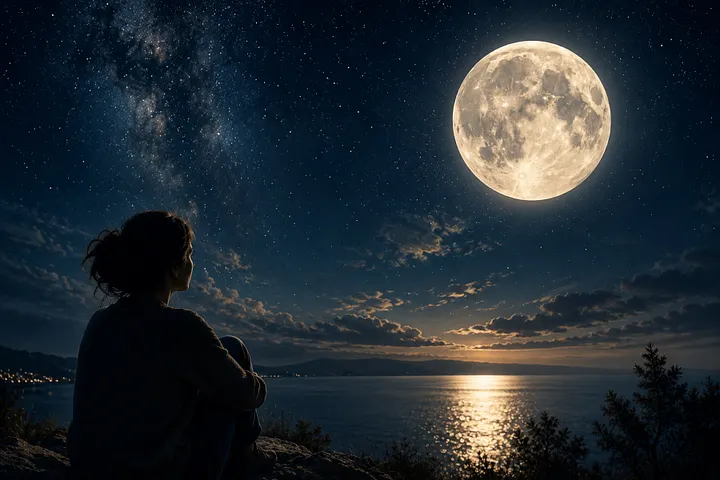
There is a peculiar moment that seems to happen every month in hospitals, emergency departments, psychiatric units and even ordinary households. Someone glances outside, notices the bright, unmistakable glow of a full moon hanging above the horizon and almost instinctively says, “Well, that explains it.” Perhaps the waiting room has been unusually chaotic, emotions seem to be running higher than usual or several difficult situations have unfolded in the span of a single evening. The remark is usually offered with a smile, but behind it often lies real conviction. Many people do not simply enjoy the folklore surrounding the full moon. They believe they have witnessed its effects firsthand.
As a clinician, I have heard these observations more times than I can count. Nurses, first responders, therapists, physicians, teachers and law enforcement officers often describe full moon nights as feeling somehow different. They are not typically people who place much stock in superstition. They are professionals who rely on evidence, routine and careful observation, yet many remain convinced that something changes when the moon reaches its brightest phase. Their confidence raises an intriguing question. Is this one of those enduring beliefs that survives because it contains a grain of truth? Or has the human mind simply become remarkably skilled at convincing itself that two unrelated events belong together?
The question is more complicated than it first appears because the moon has always occupied a unique place in human history.
Few objects in the night sky have inspired as much wonder, speculation, poetry, fear and scientific curiosity. Long before people understood gravity or circadian rhythms, they understood that the moon followed predictable cycles and that life on Earth appeared to move in rhythm with those cycles.
It illuminated the darkness, influenced the tides, marked the passage of time and became woven into stories that attempted to explain everything from fertility to madness.
A Belief Older Than Science
Ancient civilizations often viewed the moon as something far more powerful than a distant celestial body. In Mesopotamia, Egypt, Greece, Rome and countless other cultures, lunar cycles became associated with changes in behavior, emotion and health. Physicians in ancient Greece believed that the brain, because of its moisture, might respond to the moon’s influence in much the same way the oceans responded to its gravitational pull. Medieval scholars wrote of periods of confusion and agitation that appeared to coincide with the full moon, while generations of storytellers filled the night with tales of werewolves, restless spirits and transformations that occurred only beneath its light.
Even today, remnants of those beliefs remain hidden within our everyday language. The word lunatic traces its roots to the Latin word luna, meaning moon, reflecting a centuries old assumption that periods of emotional instability could be explained by lunar influence. Although the term has long since fallen out of appropriate clinical use, its history serves as a reminder of how deeply this idea became embedded within society. It was never simply folklore passed between neighbors. For much of human history, it represented what many people genuinely believed to be an explanation for unusual human behavior.
Why This Belief Refuses to Disappear
The remarkable persistence of this belief is perhaps its most fascinating characteristic. Human civilization has transformed dramatically over the past several thousand years. We have mapped the human genome, landed spacecraft on distant planets, developed advanced neuroimaging capable of watching the brain function in real time and dramatically expanded our understanding of psychology and medicine. However, despite these extraordinary advances, belief in the emotional power of the full moon has remained surprisingly steady.
Surveys continue to show that many people, including healthcare professionals, believe the full moon influences mood, behavior or mental illness in some real life way.
Beliefs that endure for generations often do so because they seem to match lived experience. People remember the unusually difficult night shift that occurred beneath a bright moon. They recall the restless evening when sleep would not come or the emotionally charged family gathering that seemed somehow more intense than usual. These memories feel persuasive because they are personal, vivid and emotionally significant. Stories passed from one generation to the next gain additional strength through repetition, gradually becoming accepted as common knowledge rather than ideas requiring proof.
The persistence of these beliefs also reflects something deeply human about the way we understand the world. Our brains are constantly searching for patterns because pattern recognition has always been essential for survival. Recognizing that certain clouds often precede storms, that particular animal tracks signal danger or that seasonal changes influence food supplies once carried enormous evolutionary advantages. The same remarkable ability that helped our ancestors survive also encourages us to connect events that occur close together in time, even when no true relationship exists. The moon, with its striking appearance and predictable rhythm, provides an especially memorable backdrop against which regular events can suddenly feel extraordinary.
The Moon’s Undeniable Influence on Earth
Adding to the mystery is the undeniable fact that the moon truly does shape life on Earth. Unlike many ancient beliefs that have been completely discarded, this one begins with something that is unquestionably real. The moon’s gravitational pull drives the ocean tides, influences coastal ecosystems and has helped stabilize Earth’s axial tilt for billions of years. Without that stabilization, our planet’s climate would likely have fluctuated far more dramatically, creating a very different environment for the evolution of life. Scientists continue to study the moon’s role in Earth’s history because its influence on the physical world is both measurable and profound.
Once people understand the moon’s effect on the oceans, it is not difficult to see how the next assumption naturally follows. If the moon possesses enough gravitational force to move unimaginably vast quantities of water across the surface of the planet every single day, why would it not also influence the human body, which is composed largely of water? On its surface, the argument seems perfectly reasonable. It appeals to intuition, and intuitive explanations might feel convincing specifically because they appear to make immediate sense.
Does That Mean It Influences Us?
The reality, however, is considerably more nuanced. Ocean tides occur because gravity acts across immense distances, creating measurable differences in gravitational force from one side of the ocean basin to the other. The human body exists on an entirely different scale. Although we are indeed composed primarily of water, the gravitational differences exerted across a body measuring only a few feet in length are extraordinarily small. From a physics standpoint, the tidal force acting on an individual person is so minimal that nearby objects can exert comparable or even greater gravitational effects. The moon unquestionably influences our planet, but whether that influence extends into human biology is an entirely separate scientific question.
That distinction has shaped decades of research. Rather than accepting ancient assumptions or dismissing them outright, scientists have spent years examining whether measurable evidence supports the belief that the full moon alters mood, increases psychiatric symptoms, disrupts behavior or influences emotional well-being. The question has been investigated from nearly every conceivable angle using hospital records, emergency department visits, psychiatric admissions, crime statistics, sleep laboratories and large population studies involving hundreds of thousands of people.
The findings that emerged would surprise many who remain convinced that the answer has always been obvious.
What the Evidence Actually Reveals
Over the past several decades, researchers have approached the question from nearly every angle imaginable. Rather than relying on anecdotes or memorable stories, they have analyzed psychiatric hospital admissions, emergency department visits, crisis calls, suicide rates, violent crime, accidental injuries and reports of aggressive behavior. These studies have been conducted across different countries, healthcare systems and populations in an effort to answer a deceptively simple question. Does the full moon consistently coincide with measurable changes in human behavior or emotional well being?
The overwhelming conclusion is that it does not.
That statement often surprises people because it seems to contradict experiences they feel certain they have witnessed. Yet when hundreds of thousands of observations are examined together, the dramatic patterns many people expect, simply fail to appear. Psychiatric units are not consistently busier during full moons. Emergency departments do not experience reliable surges in psychiatric crises. Rates of suicide, violence and accidental injury remain quite stable across the lunar cycle. While individual studies have occasionally reported small associations, those findings have generally failed to hold up when researchers attempted to replicate them using larger samples or more rigorous statistical methods. When systematic reviews and meta analyses combine the available evidence, any apparent effect becomes so small and inconsistent that it is difficult to distinguish from ordinary variation.
This does not mean unusual events never occur beneath a full moon. Of course they do. Every day somewhere in the world a psychiatric crisis unfolds, an emergency room becomes unexpectedly busy, or a family experiences an emotionally overwhelming evening. Human suffering does not pause according to the lunar calendar. What the research suggests is that these events occur with roughly the same frequency regardless of whether the moon is full, new or somewhere in between.
That conclusion, however, does not end the conversation. In one area of research, scientists continue to find results intriguing enough to warrant closer attention.
The Sleep Connection
Sleep occupies a unique place in mental health because it influences nearly every aspect of emotional functioning. It shapes attention, memory, impulse control, stress tolerance and our ability to regulate difficult feelings. Even a single night of inadequate sleep can leave people more emotionally reactive, less patient and more vulnerable to anxiety. Chronic sleep disruption, meanwhile, is associated with depression, mood disorders, cognitive decline, cardiovascular disease and a host of other health concerns.
Because sleep exerts such intense influence over the brain, researchers began asking a different question. Perhaps the moon does not alter mood directly, but maybe it alters sleep, and sleep changes mood.
Several carefully designed studies have found modest but interesting differences in sleep around the full moon. Some participants fell asleep slightly later, slept for a shorter duration or spent less time in deep sleep during the nights leading up to a full moon. Other equally rigorous investigations found no meaningful differences at all, making this one of the more debated areas of lunar research. Even among studies reporting an effect, the changes were relatively small rather than dramatic.
One explanation looks backward rather than forward. For the overwhelming majority of human history, people lived without electricity. Before artificial lighting transformed modern life, the nights preceding a full moon became progressively brighter, extending the hours during which people could hunt, travel, socialize or simply remain active outdoors. Some evolutionary researchers have proposed that our ancestors may have naturally delayed sleep during brighter lunar phases because those evenings offered valuable opportunities that darker nights did not. If traces of that adaptation remain today, they would likely appear as subtle changes in sleep timing rather than dramatic shifts in behavior.
Whether that hypothesis ultimately proves correct remains uncertain, but it offers something many theories about the full moon lack. It presents a biologically plausible explanation that can be tested rather than merely believed.
Why Smart People Still Believe the Moon Changes Us
If the scientific evidence is largely unconvincing, why do so many intelligent people remain persuaded that the full moon affects behavior?
The answer may say less about the moon than it does about the extraordinary way the human brain constructs reality.
Our minds are constantly searching for relationships between events because identifying meaningful patterns has always increased the likelihood of survival. This ability allows us to recognize familiar faces in a crowd, anticipate danger before it becomes obvious and learn from previous experiences. The very cognitive machinery that makes humans adaptable, can also persuade us that two unrelated events belong together.
Psychologists refer to one of these tendencies as confirmation bias. Once we develop an expectation, our attention naturally gravitates toward experiences that reinforce it while quietly overlooking experiences that contradict it. The process is almost entirely unconscious. A nurse may vividly remember an unusually hectic shift that happened during a full moon while forgetting dozens of equally demanding nights that occurred under completely different lunar phases. A therapist might recall several emotionally intense sessions on one memorable afternoon without recognizing that similar afternoons happen throughout the year.
Closely related is what psychologists call the availability heuristic, a mental shortcut in which vivid, emotionally charged memories feel more common than they truly are. A dramatic event remains accessible in memory because it carries emotional weight. Since a full moon is visually striking and difficult to ignore, it becomes part of that memory, strengthening the illusion that the two were connected.
Understanding these psychological processes should not be interpreted as dismissing people’s experiences. The experiences themselves are entirely real. The emotional exhaustion felt after a difficult shift is real and the frustration of a restless night is real. What science invites us to examine is whether the explanation we assign to those experiences accurately reflects what actually caused them.
The Questions That Remain
One hallmark of good science is its willingness to acknowledge uncertainty. Although most evidence argues against a broad lunar influence on human behavior, researchers continue exploring whether certain individuals may respond differently under specific circumstances.
This question has generated particular interest in bipolar disorder because of the intimate relationship between mood regulation, circadian rhythms and sleep. Clinicians have long recognized that disruptions in the body’s internal clock can precede episodes of mania or depression. Even relatively small reductions in sleep can increase vulnerability among individuals already predisposed to mood instability.
A handful of researchers have proposed that subtle lunar influences on circadian timing could contribute to these shifts in a small subgroup of people with rapidly cycling bipolar disorder. Some longitudinal studies have reported synchrony between mood episodes and lunar cycles in individual patients, while others have failed to find comparable patterns. These investigations remain limited by small sample sizes and the difficulty of separating coincidence from genuine biological effects. At present, the evidence is intriguing enough to justify continued research but far from strong enough to establish a causal relationship.
This distinction is important because scientific progress rarely moves in absolutes. Most hypotheses are not immediately proven or disproven. They are refined, challenged, replicated and sometimes abandoned altogether. The possibility that a small subset of individuals could exhibit subtle biological sensitivity to lunar cycles remains an open question, but it should not be confused with evidence that the full moon broadly alters the emotions or behavior of the general population.
Looking Up Without Looking Away
Perhaps the enduring fascination with the full moon tells us something more profound than whether it changes our mood.
It reminds us that human beings are meaning making creatures. We search for explanations when life feels unpredictable because explanations reduce uncertainty. We notice patterns because our brains have evolved to notice them. Sometimes those patterns reveal actual discoveries that transform science. Other times they reveal something equally valuable about the strengths and limitations of human perception.
As a clinician, I find that conclusion more hopeful than disappointing. If the moon governed our emotional lives, there would be little we could do to change them. Instead, decades of psychological and medical research point toward factors that genuinely shape mental health. Consistent sleep, healthy relationships, physical activity, effective stress management, meaningful purpose, proper treatment when needed and compassionate self awareness exert a far greater influence on emotional well-being than the changing phases of the night sky ever have.
The moon remains extraordinary. It steadies our planet, guides the tides and has inspired countless generations to look upward in awe. It has earned its place in mythology, literature and human imagination. What it has not yet earned, is convincing scientific evidence that it silently dictates our emotions from nearly a quarter of a million miles away.
There is something comforting about that.
The same curiosity that once led our ancestors to wonder whether the moon controlled the mind has now led scientists to ask better questions, gather better evidence and accept complexity where certainty once existed. In many ways, that is the real story. The full moon has not just illuminated the night sky, but it has illuminated something about ourselves, reminding us that the search for truth requires both imagination and humility, along with the willingness to change our minds whenever the evidence leads us somewhere unexpected.
Sources
Burgess, Helen J., et al. “Lunar Cycling in Sleep and Mood in Individuals with Bipolar Disorder.” International Journal of Bipolar Disorders 10 (2022).
Cajochen, Christian, et al. “Evidence That the Lunar Cycle Influences Human Sleep.” Current Biology 23, no. 15 (2013): 1485 — 1488.
Cordi, Maren, et al. “No Evidence for Lunar Influences on Human Sleep in a Large Sample.” Current Biology 24, no. 3 (2014): R103 — R104.
de la Iglesia, Horacio O., et al. “Moonstruck Sleep: Synchronization of Human Sleep With the Lunar Cycle Under Field Conditions.” Science Advances 7, no. 5 (2021).
Rotton, James, and Ivan W. Kelly. “Much Ado About the Full Moon: A Meta Analysis of Lunar Effect Research.” Psychological Bulletin 97, no. 2 (1985): 286 — 306.
Wehr, Thomas A. “Bipolar Mood Cycles and Lunar Tidal Cycles.” Molecular Psychiatry 23 (2018): 923 — 931.