
The Feeling That Arrives Before the Thought
You are halfway through a conversation when something changes, it is not obvious, but there is a shift. The other person’s words remain calm, their smile has not disappeared and the room looks exactly as it did a moment earlier. But somewhere outside of conscious thought, a quiet sense of unease begins to grow. You cannot explain it and if someone asked you to justify it, you probably could not. Hours later you discover that the person had been hiding something important, and suddenly that strange feeling makes perfect sense.
Experiences like this have shaped our beliefs for thousands of years. They have inspired stories of sixth senses, psychic abilities and mysterious inner voices that seem to know the future before the mind catches up. Nearly everyone has a story about following a gut feeling that turned out to be right. Just as many people can recall ignoring one they later wished they had trusted.
The question is whether intuition deserves the sort of mystical reputation it has earned. Is there truly an unexplained force guiding our decisions or is something far more fascinating happening beneath our conscious awareness?
Modern neuroscience has begun answering that question and the findings reveal something both more ordinary and more extraordinary than superstition. Your intuition is not magic, but it is also not meaningless. Instead, it is a product of a brain that is constantly gathering, comparing, predicting and interpreting information long before you become aware of it. The challenge is not deciding whether intuition exists, but learning when it reflects genuine insight and when it is simply fear wearing a convincing disguise.
Why We Call It a Gut Feeling
The language we use to describe intuition has always centered on the body. We trust our gut. We feel something in the pit of our stomach. We experience butterflies before an important decision or nerve racking event. Even when we know the brain controls thought, our instincts often seem to originate somewhere much lower.
These sensations are not just figures of speech. The brain and digestive system are linked through an intricate communication network known as the gut brain axis. Running through this network is the vagus nerve, one of the body’s longest cranial nerves, carrying signals between the brain, heart, lungs and digestive tract throughout the day. At the same time, the digestive system contains an enormous collection of neurons known as the enteric nervous system. Sometimes referred to as the body’s second brain, this network does not think independently. It constantly exchanges information with the central nervous system about internal conditions, stress levels, inflammation and emotional states.
When your brain detects something important, whether it is real danger or simply uncertainty, those signals often produce physical sensations before conscious reasoning begins. Your stomach tightens, your heart rate changes, your breathing becomes shallower and muscles prepare for action. Long before you can explain why you feel uncomfortable, your body has already begun responding.
The interaction of these physiological signals helps explain why intuition is frequently accompanied by distinct physical sensations. The sensation itself is real. The question lies in whether the message behind it is accurate.
Your Brain Is Always Working Behind the Scenes
One of the greatest misconceptions about intuition is the belief that it appears from nowhere. The reality is, the brain rarely stops collecting information. Every facial expression, change in voice, shift in posture, unfamiliar smell, environmental cue and past experience is compared with an enormous library of memories that exists largely outside conscious awareness.
Much of this process occurs automatically because conscious thought would simply be too slow. If every decision required deliberate analysis, people would struggle to navigate even routine situations. Instead, the brain constantly builds predictions about what is likely to happen next based on everything it has experienced before.
When something fails to match those predictions, certain regions of the brain start responding almost immediately. The amygdala rapidly evaluates emotionally significant information, especially anything associated with possible threat or safety. The insular cortex helps integrate signals from inside the body, allowing us to become aware of internal sensations such as tension, discomfort or calm. Only afterward, does the prefrontal cortex begin constructing the logical explanations we experience as conscious reasoning. Basically, your brain usually notices patterns before your conscious mind understands what it has noticed.
This explains why intuition sometimes seems almost supernatural. The information has already been processed, but the explanation has not yet arrived.
Why Experts Often Have Better Intuition
Not all intuition deserves equal confidence. One of the strongest findings in psychological science is that accurate intuition usually develops through repeated experience rather than mysterious ability.
Consider an experienced firefighter walking through a burning building. Without consciously identifying the exact reason, they may suddenly order everyone outside moments before the floor collapses. Later they realize they had unconsciously noticed subtle changes in temperature, smoke movement, sound and structural behavior that their brain had encountered countless times before.
Emergency physicians often describe similar experiences. An experienced clinician may enter a patient’s room and immediately sense that something is seriously wrong before laboratory results or imaging studies confirm it. They are not predicting the future. They are just recognizing patterns accumulated through years of exposure.
The same principle applies to pilots, detectives, seasoned therapists, chess grandmasters, athletes and musicians. Their instincts improve because their brains have stored thousands of previous examples, allowing unconscious pattern recognition to occur almost instantly.
This is one reason intuition becomes more reliable within areas of genuine expertise. It is less of a mysterious gift than the quiet expression of accumulated knowledge.
When Fear Pretends to Be Intuition
Although intuition can be incredibly useful, it is far from infallible. The same brain capable of extraordinary pattern recognition is also vulnerable to distortion.
Anxiety illustrates this perfectly. Someone living with chronic anxiety often experiences intense certainty that something terrible is about to happen. Their body reacts with racing thoughts, muscle tension, rapid heartbeat and overwhelming urgency. These sensations can feel identical to what many people describe as intuition, but they are driven primarily by an overactive threat detection system rather than accurate environmental assessment.
Trauma can create a similar challenge. Individuals who have lived through frightening experiences often develop heightened sensitivity to cues that resemble previous danger. Their nervous system learns to react quickly because rapid detection once promoted survival. Unfortunately, the brain sometimes generalizes those patterns too broadly, causing harmless situations to trigger the same alarm response.
Cognitive biases add another layer of complexity. Confirmation bias encourages us to notice evidence supporting beliefs we already hold while overlooking contradictory information. The availability heuristic makes dramatic memories seem more common than they actually are. Emotional reasoning convinces us that because something feels true, it must be true.
Together these processes can create extraordinarily convincing instincts that are nevertheless inaccurate. This does not mean intuition should be ignored. It means intuition should be interpreted with curiosity instead of unquestioning certainty.
Does Intuition Predict the Future?
Many people describe experiences that seem impossible to explain. They think about an old friend moments before receiving a phone call. They cancel a trip because something feels wrong, only to learn there was an accident along the intended route. These experiences are emotionally powerful and it is understandable why they leave lasting impressions.
Science approaches these stories differently than superstition does.
Human memory is selective. We naturally remember striking coincidences, while forgetting the countless occasions when similar feelings led nowhere. Because emotionally significant events are stored more vividly, successful predictions become memorable stories while unsuccessful ones quietly disappear.
Researchers have spent decades investigating claims of precognition and extrasensory perception. While individual studies occasionally generate intriguing findings, repeated attempts to reproduce robust evidence under controlled conditions have not demonstrated reliable proof that people can consistently perceive future events before they occur.
That conclusion may disappoint those hoping for something supernatural, but it should not diminish the remarkable abilities we already possess. The human brain is an astonishing prediction machine and continuously forecasts outcomes based on previous experience, current environmental information and unconscious pattern recognition. Those predictions can sometimes appear almost magical precisely because the calculations occur outside conscious awareness.
The mystery, however, is not paranormal. It is neurological.
Learning When to Listen
Perhaps the healthiest relationship with intuition is neither blind trust nor complete skepticism.
When a feeling arises, it can be helpful to ask where it might be coming from. Is it emerging within an area where you have years of experience or is it appearing during a period of exhaustion, panic, grief or overwhelming stress? Is your body alerting you to subtle information you have not consciously processed or is your nervous system replaying an old pattern that no longer fits the present moment?
Intuition works best when paired with reflection. It provides valuable information, but it almost never tells the entire story. In clinical practice, this distinction often becomes especially important. Many people struggle because they have learned to distrust every instinct after making painful mistakes. Others experience the opposite problem, treating every strong emotion as unquestionable truth. Both extremes overlook the complexity of how the brain actually works.
Healthy decision making involves allowing intuition to speak without giving it complete authority. Sometimes your instincts deserve immediate attention because they are drawing upon years of experience your conscious mind has not yet organized into words. At other times, they deserve gentle examination because anxiety, trauma or cognitive bias may be shaping the message.
The Remarkable Mind Behind Every Gut Feeling
The most surprising discovery about intuition could be that understanding its biology does not make it any less extraordinary. If anything, neuroscience makes it even more impressive.
Inside your brain, billions of neurons are constantly comparing present experiences with a lifetime of memories, detecting subtle patterns, monitoring internal bodily signals and generating predictions before conscious awareness has time to catch up. What feels like a mysterious whisper from somewhere beyond reason is often the quiet work of one of the most sophisticated information processing systems known to science.
Your instincts are neither infallible nor imaginary. They are an invitation to pay attention.
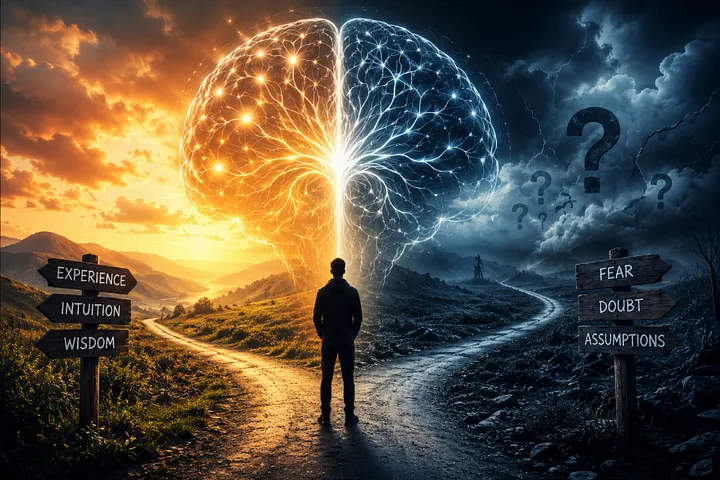
Sometimes they are the voice of wisdom earned through experience. Sometimes they are the echo of fear shaped by the past. Learning the difference may be one of the most valuable psychological skills a person can develop. The goal is not to silence intuition or surrender to it, but to understand it well enough that when your gut speaks, you know how to listen with both curiosity and discernment.
Sources
Bechara, Antoine, Hanna Damasio, and Antonio R. Damasio. “Emotion, Decision Making and the Orbitofrontal Cortex.” Cerebral Cortex 10, no. 3 (2000): 295 — 307.
Craig, A. D. “How Do You Feel? Interoception: The Sense of the Physiological Condition of the Body.” Nature Reviews Neuroscience 3, no. 8 (2002): 655 — 666.
Gigerenzer, Gerd. Gut Feelings: The Intelligence of the Unconscious. New York: Viking, 2007.
Kahneman, Daniel. Thinking, Fast and Slow. New York: Farrar, Straus and Giroux, 2011.
Mayer, Emeran A. The Mind Gut Connection. New York: Harper Wave, 2016.
Pessoa, Luiz. The Cognitive Emotional Brain: From Interactions to Integration. Cambridge, MA: MIT Press, 2013.
Sapolsky, Robert M. Behave: The Biology of Humans at Our Best and Worst. New York: Penguin Press, 2017.
Stanovich, Keith E. Rationality and the Reflective Mind. New York: Oxford University Press, 2011.