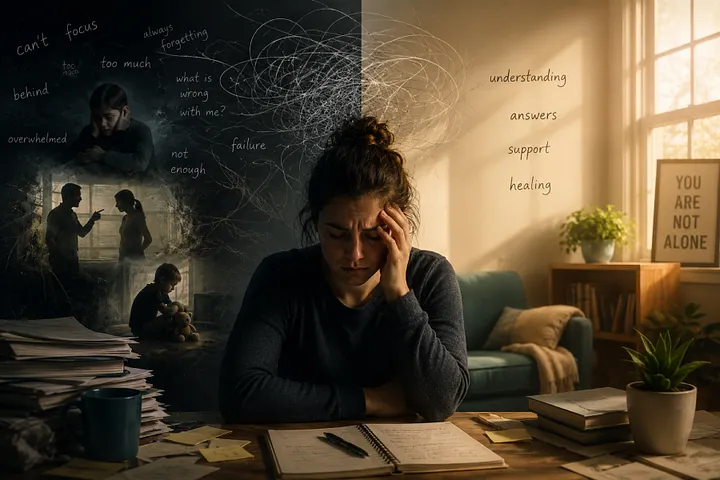
A twenty-eight-year-old walks into a mental health clinic exhausted by the feeling that life never seems as manageable for them as it does for everyone else. Conversations fade before they reach the end. Bills disappear into unopened piles of mail. Projects begin with genuine enthusiasm and quietly stall. Friends tease them for never listening. Employers have called them careless. By the end of the appointment, they leave with a diagnosis of attention-deficit/hyperactivity disorder.
Later that day, someone else sits in another office describing much the same life. They cannot focus. Appointments come and go without notice. Normal responsibilities feel far more difficult than they seem to for the people around them.
Instead of asking about attention, the clinician asks something else.
“What was your childhood like?”
Over the next hour, missed appointments lead to memories of forgotten birthdays. Difficulty concentrating gives way to stories of listening for raised voices behind a bedroom door. Restlessness begins to make sense in the context of a childhood where being alert was often more important than being calm. The symptoms are the same, but the experience behind them is not.
ADHD is a real and often life-changing diagnosis for millions of people. Yet difficulty paying attention, staying organized and managing impulses does not belong exclusively to ADHD. Different experiences can leave people with strikingly similar symptoms, and one of the most overlooked begins in childhood.
Sometimes the diagnosis is ADHD. Sometimes those same behaviors are the echoes of years spent adapting to fear, instability or neglect.
A diagnosis should do more than describe what someone struggles with. It should help explain why those struggles began and point toward the treatment most likely to change their life.
ADHD Is Real. That Is Not the Question.
For many people, an ADHD diagnosis is the first explanation that finally makes sense.
After years of wondering why simple responsibilities seemed harder than they did for everyone else, the diagnosis gives a name to a struggle that had often been mistaken for laziness, carelessness or a lack of motivation. What once felt like a personal failure begins to look like something that can be understood and treated.
It is a neurodevelopmental disorder that has been studied for decades. It typically begins in childhood and involves differences in executive functioning, the mental abilities that help us regulate attention, organize our lives, manage impulses and carry plans into action. For millions of children and adults, an accurate diagnosis leads to treatments and practical strategies that make school, work, relationships and everyday life more manageable.
The problem is not recognizing ADHD when it is there. The problem is assuming that every difficulty with attention has the same explanation.
Trouble concentrating, forgetfulness, restlessness, impulsivity and disorganization are symptoms, not diagnoses. They can emerge from different conditions, different life experiences and different developmental histories. Looking only at the symptoms can make two very different lives appear almost identical.
A good diagnosis does more than describe what someone is experiencing. It explains how they arrived there.
That is the question this article explores.
When the Brain Grows Up Under Different Conditions
If a diagnosis is meant to explain how someone arrived here, the story usually begins in childhood.
For some children, the world is predictable. Adults keep their promises. Home feels safe. Mistakes are met with patience instead of fear. Those are the years when children gradually learn to focus in school, solve problems, recover from disappointment and trust that tomorrow will probably look much like today.
Not every childhood teaches those lessons.
Some children learn to recognize the sound of an argument before the first word is spoken. Others study a parent’s face before deciding whether it is safe to ask a question. They learn that a regular evening can change in an instant and that paying close attention to the people around them is often more important than paying attention to anything else.
Psychologists refer to experiences such as abuse, neglect, domestic violence, parental substance use and severe mental illness in the home as Adverse Childhood Experiences, or ACEs. They do not define a person’s future, and many people who experience them grow into healthy, resilient adults. They do, however, shape the way a developing brain responds to the world around it.
When a child’s environment is unpredictable, constant awareness is not a weakness. It is often the skill that keeps them safe.
When Adaptation Looks Like ADHD
The skills that help a child survive are not always the ones that make adulthood easier.
A child growing up in an unpredictable home learns to notice what other children never have to think about. A change in a parent’s voice. Footsteps outside a bedroom door. The expression on someone’s face before a single word is spoken. Paying attention to those details is not a distraction. It is part of staying safe.
Those habits rarely disappear because the child grows up.
Years later, that same person may find themselves reading the same paragraph three times before it finally sinks in. They may lose track of a conversation because another person’s tone suddenly feels familiar. By the end of the day, they are exhausted without being able to explain exactly what drained them.
Those struggles can look remarkably similar to ADHD. Yet the paths that lead there can be entirely different. Looking at the symptoms alone tells us where someone is.
Understanding the life behind them tells us how they got there.
Why the Difference Matters
A checklist can tell us which symptoms someone has. It cannot tell us how they got them. That is why a good evaluation sounds less like an interrogation and more like a conversation.
“When do you remember first struggling with this?”
“What was happening at home back then?”
“Has it always been this way?”
Questions like these are not looking for reasons to rule out ADHD. They are trying to understand the person behind the symptoms.
Medication can be life changing for someone with ADHD. Therapy may be equally life changing for someone whose attention has been shaped by years of adapting to an unpredictable world. When both are present, both deserve to be recognized.
The checklist tells us what someone is experiencing.
The conversation begins to tell us why.
What Decades of Research Have Revealed
As researchers followed children over time, they began to notice the same pattern.
Children who had experienced adversity were more likely to struggle with attention, emotional regulation, organization and impulse control. They were also more likely to receive an ADHD diagnosis than children whose early lives had been more stable.
That observation led to important questions.
Were these children developing ADHD? Were they experiencing the lasting effects of chronic adversity? Or were both shaping the same life at once?
The answer turned out to be more complicated.
Some children have ADHD. Some develop attention difficulties that grow out of chronic adversity. Many experience both. Looking at symptoms alone is often not enough to understand what is happening.
Decades of research have shown that the farther researchers looked beneath the symptoms, the more often they found themselves looking at childhood.
Not because every child with ADHD has experienced adversity.
Not because every child who experiences adversity develops ADHD.
Because understanding either condition begins with understanding the child’s development long before anyone considered a diagnosis.
What a Good Assessment Looks Like
Most people expect an ADHD evaluation to focus on attention.
A good one does not stay there.
It starts with the symptoms and reaches further back.
Childhood becomes part of the conversation because ADHD almost always begins early. School often follows, where old report cards and teacher comments sometimes remember what we no longer can. Then come questions about relationships, sleep, anxiety, depression, physical health and substance use, because every one of those can shape the way attention functions.
By the end of the appointment, the conversation has often arrived somewhere unexpected. Someone who thought they would spend an hour talking about difficulty concentrating at work may instead find themselves remembering elementary school, describing life at home or realizing they have not slept well in years.
None of that is a detour. It is the assessment.
A diagnosis means far more when it reflects a person’s life, not just a list of symptoms.
The Questions Worth Asking
Most people begin this process with a single question.
“Do I have ADHD?”
It is an important question. For millions of people, an accurate diagnosis brings relief, direction and treatments that can change their lives.
Sometimes another question is just as important.
“What happened to me?”
For some people, the answer is ADHD. For others, it is years of chronic stress, trauma or instability that quietly shaped the way they learned to pay attention to the world. For many, it is both.
The first two people in this article walked into different offices carrying nearly identical struggles.
One question changed the conversation.
“What was your childhood like?”
Sources
1. American Psychiatric Association. Diagnostic and Statistical Manual of Mental Disorders. 5th ed., text rev. (Washington, DC: American Psychiatric Association Publishing, 2022).
2. Centers for Disease Control and Prevention. “About Adverse Childhood Experiences (ACEs).” Last reviewed April 16, 2024.
https://www.cdc.gov/aces/about/index.html.
3. Felitti, Vincent J., Robert F. Anda, Dale Nordenberg, David F. Williamson, Alison M. Spitz, Valerie Edwards, Mary P. Koss, and James S. Marks. “Relationship of Childhood Abuse and Household Dysfunction to Many of the Leading Causes of Death in Adults: The Adverse Childhood Experiences (ACE) Study.” American Journal of Preventive Medicine 14, no. 4 (1998): 245 — 258.
4. Bessel van der Kolk. The Body Keeps the Score: Brain, Mind, and Body in the Healing of Trauma. New York: Viking, 2014.
5. Russell A. Barkley. Taking Charge of ADHD: The Complete Authoritative Guide for Parents. 4th ed. New York: Guilford Press, 2020.
6. Joel T. Nigg. Getting Ahead of ADHD: What Next-Generation Science Says About Treatments That Work — and How You Can Make Them Work for Your Child. New York: Guilford Press, 2017.
7. Nadine Burke Harris. The Deepest Well: Healing the Long-Term Effects of Childhood Adversity. Boston: Houghton Mifflin Harcourt, 2018.