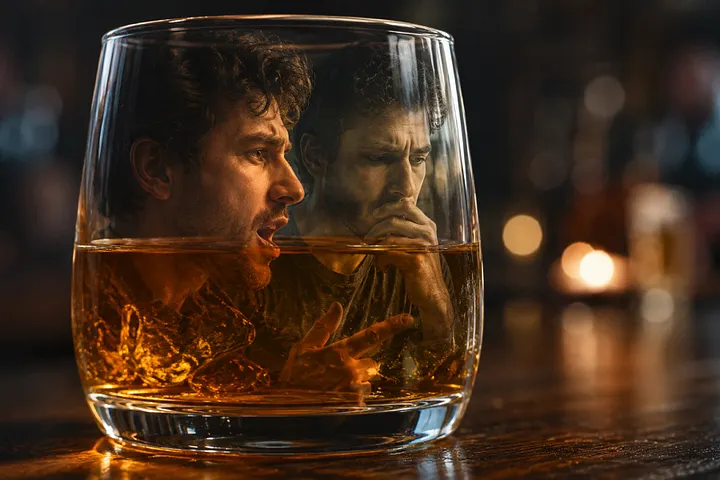
It’s after midnight. The glasses have been refilled a few times, the conversation has gotten louder and everyone is saying a little more than they were a few hours ago. Then, somewhere between one story and the next, someone looks at you and says it.
“I’ve always had feelings for you.”
It could be a friend or someone you’ve quietly wondered about for months. Or maybe what comes out is something you never wanted to hear. “I’ve never liked you.” Suddenly, you’re trying to decide how seriously to take the words of someone who has been drinking. You know they’re drunk. You also know you heard what you heard.
By morning, they want the words back. I was drunk. Forget I said it. I didn’t mean it. They get to blame the alcohol and move on with their day. You’re the one left thinking about the conversation, replaying it and wondering which version of this person you’re supposed to believe.
We have a saying for moments like this. Drunk words are sober thoughts. It sounds convincing. Alcohol lowers inhibitions, so whatever comes out after a few drinks must have been there all along.
But that assumes alcohol only changes our willingness to speak.
Losing your filter and telling the truth are not necessarily the same thing.
The Myth of the Truth Serum
There’s a reason we believe alcohol makes people more honest. Sometimes it does. Affection gets expressed. Resentments come out. Someone admits an attraction, starts the argument they have been avoiding or finally tells a story they have kept buried for years. Sometimes what slips out really is something a person has been holding back.
But alcohol doesn’t just make us more willing to say what we’re thinking. It can change the thinking itself.
As we become intoxicated, it gets harder to control impulses, weigh consequences and hold competing thoughts in mind at the same time. Our attention can narrow too, a phenomenon known as alcohol myopia. Whatever feels most important in that moment can command our attention, while everything that might complicate it starts slipping out of view.
We tend to imagine alcohol taking the editor out of the room, leaving our hidden thoughts free to spill onto the page. If that were all alcohol did, drunk words are sober thoughts might be a pretty good rule.
But alcohol can also change which pages the editor gets to read.
You Can Mean It Without It Being the Whole Truth
We contradict ourselves all the time. You can love your partner and, in the middle of an argument, genuinely want them to leave you alone. You can adore your family and resent them. You can value a friendship and occasionally find that person unbearable. You can be attracted to someone without wanting anything to happen between you.
None of those feelings makes the others less real.
When we’re sober, we’re generally better at keeping those contradictions in perspective. I’m furious with her right now, but I love her. What she did hurt me, but I understand why she did it. Part of me wants to say something cruel, but I know I’ll regret it tomorrow. The anger is real, but so is everything surrounding it.
Alcohol can make it harder to hold all of that together at the same time.
So when someone who has been drinking looks at you and says, “I’ve always hated you,” there may be real anger behind the words, even resentment they have never admitted before. In that moment, they may mean every word.
That still doesn’t mean you’ve finally discovered what they really think of you. One feeling may simply have gotten so loud that, for a while, they can’t hear much else.
We give drunken statements extra weight because they are unrestrained, as though removing restraint brings us closer to the truth. But louder doesn’t mean truer.
A drunk thought can be genuine without being the whole truth.
So What About the Thing They Said Last Night?
So what do you do with the words that started all of this?
After three drinks, a friend tells you they’re attracted to you. Your partner says they don’t love you anymore. Someone admits they’ve always been jealous of you, says something vicious during an argument or reveals a secret they have never told anyone before.
How much of it should you believe?
Telling you something that happened is different from telling you how they feel. “I slept with someone else last year” is a claim about an event. It happened or it didn’t. “I’ve never loved you” tries to sum up years of emotion in a sentence spoken by someone whose judgment and perspective are altered. Alcohol doesn’t automatically make either statement true or false, but we shouldn’t treat them the same way.
The question isn’t only whether they meant it while they were drunk. They might have. What more important is if those words survive the morning.
If they confessed an attraction, ask about it again. If an insult exposed resentment, talk about what was underneath it instead of pretending the night never happened. If they revealed a secret, don’t dismiss it simply because alcohol was involved.
What gets said after a few drinks may be worth another conversation.
It just shouldn’t get the final word.
The Least Filtered Version of You Isn’t Necessarily the Realest
So, does alcohol make you tell the truth?
Sometimes it makes a truth easier to say. A secret someone has been afraid to disclose finally comes out. An attraction they have deliberately hidden becomes harder to conceal. Anger they have swallowed for years gets spoken aloud.
But alcohol can also take whatever feels enormous in one moment and make everything else harder to reach. Those feelings may be genuine. What becomes less reliable is the ability to weigh them against everything else you know.
That may be where drunk words are sober thoughts gets it wrong. We tend to assume that once restraint disappears, we finally meet the person underneath, as though the sober version is wearing a mask made of judgment, perspective and empathy.
But those things aren’t a mask.
Restraint is part of us too. So is reconsidering something before we say it, recognizing that we can feel two opposing things at once and deciding that not everything we think needs to be said.
The sober version of you isn’t necessarily the censored version. Sometimes it’s simply the version that can recognize that one feeling isn’t all of you.
Alcohol may reveal a truth.
That doesn’t mean it reveals the truth.
Sources
Steele, Claude M., and Robert A. Josephs. “Alcohol Myopia: Its Prized and Dangerous Effects.” American Psychologist 45, no. 8 (1990): 921 — 933.
Steele, Claude M., and Leonard Southwick. “Alcohol and Social Behavior I: The Psychology of Drunken Excess.” Journal of Personality and Social Psychology 48, no. 1 (1985): 18 — 34.
McPhee, Matthew D., and Christian S. Hendershot. “Meta-analysis of Acute Alcohol Effects on Response Inhibition.” Neuroscience & Biobehavioral Reviews 152 (2023): 105274.
Spinola, Sara, Michael Maisto, and colleagues. “Effects of Acute Alcohol Administration on Working Memory: A Systematic Review and Meta- analysis.” Psychopharmacology (2022).